
WHY YOU KEEP FALLING FOR THE SAME TYPE
A honest look at attachment theory, relational patterns, and the people we keep choosing (a guide for the self-aware and the frustrated)

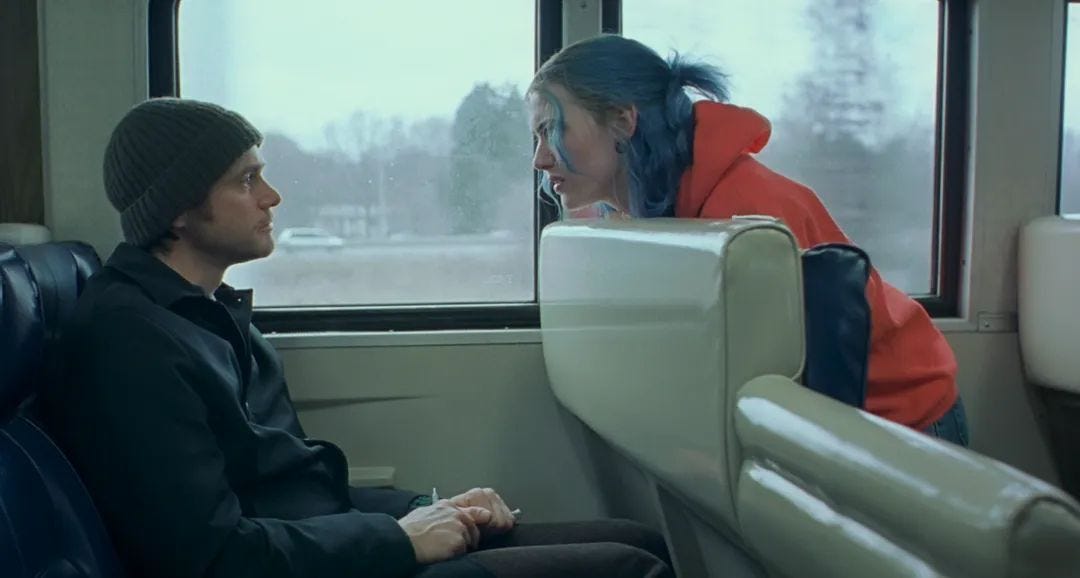
There’s a story a lot of people like to tell themselves when it comes to love, and it goes something like this: I have terrible luck in partners. I always end up hurt, and I don’t know why it keeps happening to me.
Relatable. Also, possibly (read: probably) not the whole story.
We tend to act like our relationships and our romantic partners are like the weather; we unsuspecting victims were innocently standing outside, minding our business, and somehow, emotionally unavailable people just keep falling on our heads!
Yes, I am aware that the funniness of this joke is inversely correlated with its relatability. But what I’m trying to slowly nudge towards (with humor) is the uncomfortable idea that you’re probably not a passive recipient of your dating history. Or as the old saying goes, it takes two to tango.
And look - sometimes we have bad luck in love. I don’t know your specific situation, nor do I want to generalize or minimize your experience. But if you opened up on this chaotic little piece of mine, there’s a decent chance some part of you already suspects that luck isn’t the whole story.
The Part Where I Ruin the Concept of Chemistry For You
The word I liked to use when I met someone who was eventually going to cause me significant emotional distress was connection, spark, or chemistry. Occasionally, if I was really in a limerent mood, I might have even gone for soulmate.
In this other piece of mine, I write about limerence and how we often confuse the biochemical rush of pair-bonding for chemistry or, even worse, love.
Limerence is a heightened state of romantic infatuation characterized by intrusive, obsessive thoughts about another person, a strong longing for emotional reciprocation, and an idealized perception of the other.
One thing I highlighted is what psychologists call a “limerence avatar” - the type of person who is often your personified love potion. Or often more accurately, they are your custom-made flavor of poison.
Often (but not always), your limerence avatar isn't a type you invent so much as a type you recognize. Setting aside the nuance for a moment, the human brain is primarily a pattern-matching organ. It is exquisitely tuned to find the familiar and file it under safe - even when the familiar is, objectively, not safe at all. This is useful if you’re a prehistoric human trying to avoid being eaten. This is less useful if you grew up in a household where love came packaged with inconsistency, criticism, or emotional withdrawal, because now your nervous system has learned to read those things as home. And this is the opposite of useful when you meet who gives you that particular cocktail of warmth and withholding - who makes you feel slightly off-balance, like you’re always one wrong move from losing them it. Because when that happens, it doesn’t feel like a red flag. It might just feel like falling in love.
The Part Where I Mansplain Attachment Theory
At some point in the cycle (usually after the third or fourth iteration, sometimes accompanied by a therapist or a very patient friend), people arrive at attachment theory. (If you don’t know what that is, I might be your patient friend, and you can find a brief introduction here.)
When this moment inevitably arrives in your life (a canon event for all us self-reflective self-help obsessed empaths), this is what tends to happen. First, you learn the words (anxious, avoidant, secure). Then, you identify yourself (usually as anxious, because avoidant people are less likely to be sitting with a self-help book at 11 p.m.), then you identify your partners (avoidant, obviously), and then you nod along feeling understood.
(And then you close the book, the blog, the TikTok, or wherever it is you got this information - and go about your day, until you encounter another avoidant out in the wild and get to scream “avoidant!!” at them when it all goes to shit.)
The problem is that the theory often stops here, and what is often left missing is this: anxious attachment and avoidant attachment are not just complementary puzzle pieces that happen to find each other through bad luck. They are, in many cases, a dynamic that both people are actively - if unconsciously - choosing, because it confirms something each of them already believes about love.
The anxious person believes, at some foundational level, that they are too much. They often believe that love is something you have to earn and maintain through constant vigilance, and that any reduction in attention from a partner is evidence of incoming abandonment. In other words, the anxious person doesn’t just stumble into avoidant partners - they often select for them. A secure, consistently present partner frequently doesn’t produce that familiar charge, and so gets quietly filed under something’s missing before being exited.
The avoidant partner, meanwhile, is deeply uncomfortable with emotional dependency. They often grew up learning that needing people led to disappointment, so they became very self-sufficient, and now find themselves inexplicably drawn to anxious partners because the emotional chasing gives them just enough intimacy to feel connected while still maintaining the distance that keeps them from feeling trapped. And conveniently, their traits tend to self-select for anxious partners anyway, since secure people usually get tired of the inconsistency and move on to greener pastures.
Yes, this is simplified, but my point is that both tend to find each other - across cities, decades, dating apps, and odds. My larger (long-winded) point: attachment style is often used as a way to understand the pattern without actually changing anything.
The Part Where I Tell You What to Do
I’ve been yapping for a hot second, and if you’re currently screaming “just tell me what to do” at your screen - here are four things (in roughly the order you should try them).
1. Start treating your own dating history as data
Most people exit relationships with a narrative. He was emotionally unavailable. She was controlling. It just didn’t work out. The narrative is tidy and it casts you as the observer of your own story rather than a participant in its mechanics.
What’s more useful (and significantly more uncomfortable) is an audit. When you’re ready, take an actual honest accounting of your patterns: who you’ve been drawn to, what the early dynamic looked like, when things started to go sideways, and crucially - what you did in response to the first signs that this was heading somewhere familiar. Did you bring it up, or did you minimize it? Did you leave, or did you stay and hope? Did you notice the thing that eventually ended it in month eight, back in month two and choose not to see it?
This is the self-sabotage question, and it deserves a real answer because self-sabotage rarely feels like obvious self-destruction. Instead, it usually feels like reasonable logic because at some point in your life, it probably was reasonable. If you learned early that expressing needs got you punished, ignored, or abandoned, then minimizing those needs was actually a smart adaptation. The problem is that strategies built for survival in one environment don’t automatically update when the environment changes. You carry them forward into new relationships, new people, new situations and apply the same fear-based template to contexts that no longer require it.
The point here is to update your nervous system sofware and extract a tangible lesson - not a vague I need to choose better but something that can become a concrete data point going into the next relationship.
TLDR: Your dating history is a dataset that you have been collecting for years, and at some point, it might actually be worth looking at it.
(PS: If you’re reading and nodding along to this piece, the point is probably now).
2. Ask yourself what the dynamic was giving you
Once you’ve figured out your favorite custom flavor of chaos, abandon the question of why do I keep falling for this type?!?! Instead, start asking the more helpful question: what did this dynamic give me?
Because it’s giving you something. It might be the subconscious comfort of knowing exactly how this story goes. It might be the validation of feeling like the reasonable one. It might be the adrenaline of an on-again-off-again that makes you feel more alive than calm relationships do. It might even be - gasp! - the pain itself, because it confirms a story you’ve been telling about yourself: that people leave you, that you are unlovable, that this is just how love goes for someone like you.
Once you know why you are attracted to certain people and dynamics, you take the first steps towards demystifying your intrigue and start retraining your attraction to respond to healthier and more sustainable partners.
“When we confuse intensity with destiny and calm with its absence, we walk past the very people and relationships that might have worked had we given them a chance.” - Lies You’ve Been Told about Love
3. Integrate what you’ve learned before the next relationship starts.
This is the long game, and it’s where the work from steps one and two actually gets used. This step begins with learning to notice the pull of familiarity before you’ve already followed it. It begins with treating that feeling of intense early chemistry with suspicion. As in: interesting that this feels so charged so fast. Let me watch what happens next instead of deciding they are my soulmate.
The annoying part is that changing your natural preference is often not simply a matter of making better choices next time. You can’t logic your way out of a nervous system response. What actually shifts the pattern is developing enough self-awareness - usually through sustained effort, often with professional help - that you can catch the moment when familiar starts masquerading as right, and pause long enough to ask whether you actually want what you’re about to reach for.
4. Actually work on your attachment style (or at least start dating with it in mind)
And by “working on it” I don’t mean knowing what it is. Knowing your attachment style and changing your attachment style are about as related as reading about running and running a 5K. For anxiously attached people, this often means learning that asking for reassurance is not the same as being needy, and that a partner who makes you feel chronically uncertain is not someone you’re failing to keep but someone who is not interested in keeping you. For avoidantly attached people, it means practicing the genuinely terrifying act of letting someone see that you need them, and finding out that the world does not, in fact, end.
IN CONCLUSION: there may be a chance that you have bad luck in love because you’re trying to find it with a map you drew up a long time ago, by a much younger version of you, under conditions you didn’t choose. And sometimes, the only solution is that you’ve got to throw away that map.
If you’re reading this with a slow-dawning sense of oh no I was the problem, please know that none of this means you’re broken, or that you should be embarrassed, or that the pain you’ve experienced isn’t real. It means you’re human, doing what humans do: repeating the patterns that feel most like yourself, even when those patterns aren’t serving you.
Ultimately, know this: the goal is not to become someone who never feels the pull of the old pattern. The goal is to become someone who feels it, recognizes it for what it is, and occasionally (hopefully more often over time) chooses differently.
And yes, I know that’s harder than identifying your attachment style in a quiz. But, unfortunately, it’s also the only version of this story that has a different ending.
If you’ve been reading along and want to support what I’m building here, buying me a coffee is a wonderful way to do it ☕️


In a conversation today, a friend reminded me that family and "familiar" come from the same root. And, at 75, having struggled with wounds so great that all I could do was deny them for decades, I see that I sought to attach to others who felt just like family ... and that was the problem. Only every single time. So glad to see someone so young coming to clarity about this earlier in your life and sharing your clarity with generosity of spirit.
What struck me most in this piece is the quiet tragedy of how human beings return to what wounds them simply because it feels familiar.
Not every attachment is love.
Sometimes it is fear of abandonment.
Sometimes loneliness.
Sometimes the hope that this time another person will finally heal something much older than the relationship itself.
And yet people continue searching for closeness anyway.
I write about those emotional patterns inside toxic families, relationships and systems of invisible power.